The Wedding Menu: Plated, Family-Style, Stations or Buffet
How you serve dinner decides how the evening moves, how much it costs and whether anyone goes hungry. A guide to the four service styles and the menu itself.
Couples spend hours choosing between the salmon and the chicken and almost no time on the decision that matters more: how dinner is served. Plated, family-style, stations and buffet produce four entirely different evenings, even with identical food. Choose the service first; the menu follows.
The four styles
Plated. Every guest is served the same courses at the table, often with a choice of main course ordered in advance on the reply card. It is the most formal option, the easiest to keep on schedule, and the one that lets you plan toasts precisely between courses. It needs more staff, and it needs place cards so that servers know who ordered what — see the guest list and the seating plan.
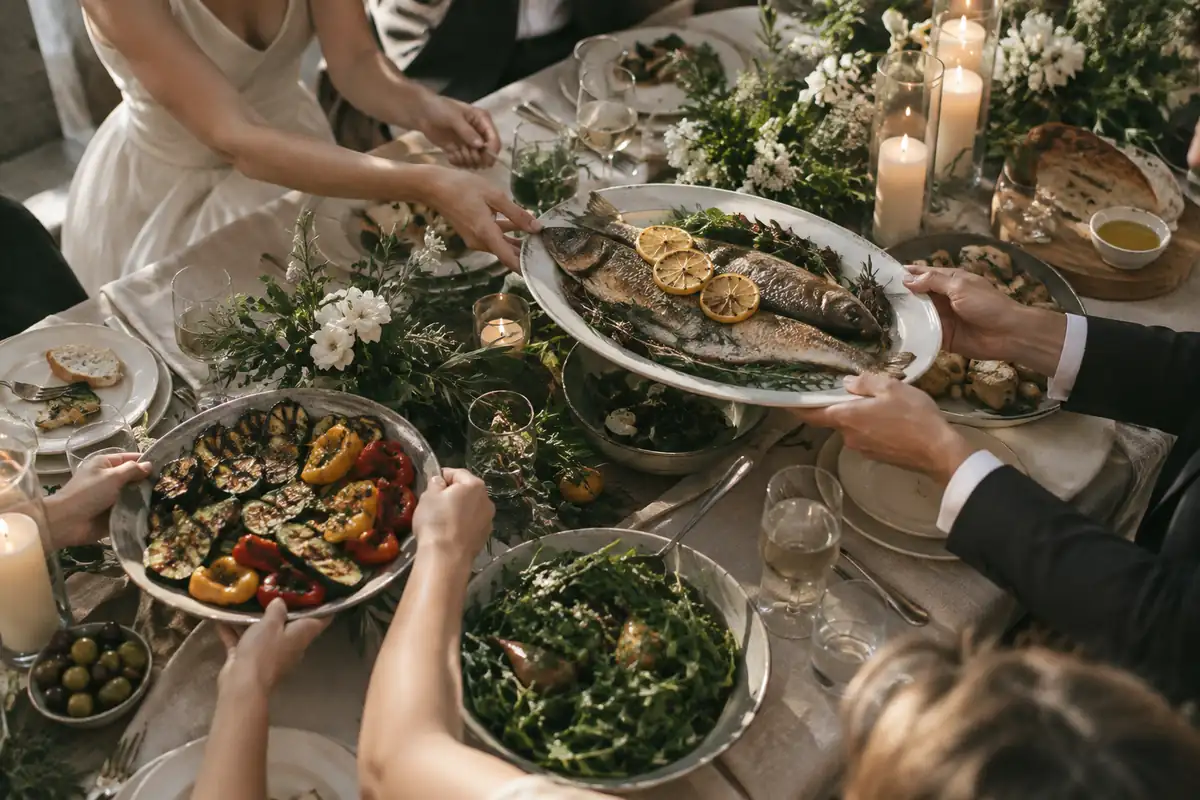
Family-style. Large platters and bowls are set on each table and passed from guest to guest. It is the most convivial option: strangers talk because they have to ask for the potatoes. It needs wider tables to hold the platters, generous quantities so the last person at each table isn’t left with the edges, and at least as many staff as plated service to keep the dishes coming.
Stations. Separate counters — a carving station, a pasta station, a raw bar — where guests collect food themselves, often cooked or finished to order. They look wonderful and let you serve a wide variety. They also need space, create queues if there aren’t enough of them, and tend to make dinner less of a shared moment. Plan one station per 50 to 75 guests.
Buffet. Everything laid out together; guests serve themselves. The most flexible and, in principle, the cheapest — though the saving is often smaller than expected, because buffets need more food to ensure the last tables are served as well as the first. Release tables to the buffet one at a time so nobody queues for twenty minutes.
Plated, family-style, stations and buffet produce four entirely different evenings, even with identical food.
Cocktail hour
The hour between the ceremony and dinner is when guests are hungriest and most likely to drink on an empty stomach. Plan six to eight passed canapés per guest for an hour — more if dinner will be late — and at least one substantial one. If the ceremony ends mid-afternoon and dinner is at seven, something more substantial is kind.
The menu
Serve food you would want to eat on a Tuesday. Weddings are no place for the chef’s experiment. Familiar dishes, beautifully done, please far more guests than an ambitious menu that half the room picks at.
Eat with the season. Produce at its peak tastes better and costs less. A summer menu of tomatoes, stone fruit and grilled fish; an autumn one of squash, mushrooms and slow-cooked meat.
Plan for dietary needs from the start. Ask about allergies and requirements on the reply card or website, and give the caterer a final list with each guest’s name and table. A good caterer will make the vegetarian or allergy-safe option as considered as the main menu, not an afterthought.
Think about the time of day. A lunch wedding can be lighter and more relaxed; a late dinner needs to be generous, especially if dancing will run late. Many couples now add a late-night snack — something hot and simple around eleven — which guests invariably remember.
Drinks
A full open bar is generous and the most expensive option. A limited bar — beer, wine and one or two signature cocktails — keeps costs predictable and is entirely normal. Ask whether you’ll be charged per drink, per person per hour, or by the bottle opened, and whether you may supply your own wine for a corkage fee. Always make sure there is something good that isn’t alcoholic.
What to ask a caterer
- Is there a tasting, and is it credited against the booking?
- What is the service charge, what is it for, and does tax apply on top? Service charges of twenty percent or more on the largest line of the budget are common; see the wedding budget.
- How many staff per guest for the style you’ve chosen?
- Are rentals included — plates, glassware, linens — or separate?
- Is there a cake-cutting fee? See ordering the wedding cake.
- Do you need to provide meals for vendors — photographers, band, coordinator? You usually do.
- What happens to leftovers? Some venues allow food to be donated or boxed for the couple.
The archive’s guide on how to interview a caterer has a longer list of questions, and low-cost catering ideas collects readers’ ways to do it for less.
Written and edited by the Today’s Weddings editors. How we research and check what we publish is set out in our editorial standards. Spotted something wrong? Tell us.