Puerto Rican Wedding Traditions
Capias and the bride’s doll, the thirteen arras, the padrinos, the bizcocho under its meringue and a dance floor that doesn’t empty — the customs of a Puerto Rican wedding, explained.
A Puerto Rican wedding brings together Spanish Catholic ritual, the island’s African and Taíno heritage, and a very Caribbean conviction that a celebration should last until the band is exhausted. Some of its customs are shared with weddings across Latin America; a few are distinctively Puerto Rican. Families vary enormously — there is no single correct version — but these are the traditions you are most likely to meet, and what they mean.
The padrinos
Padrinos and madrinas — godparents of the wedding — are close relatives or friends honored with a role in the marriage. They are more than witnesses: they are chosen to support the couple through the marriage itself. In a Catholic ceremony, particular padrinos may present the rings, the arras or other symbolic items, and traditionally some of them helped with the costs of the wedding. Being asked is a serious honor, and a lifelong one.
The arras
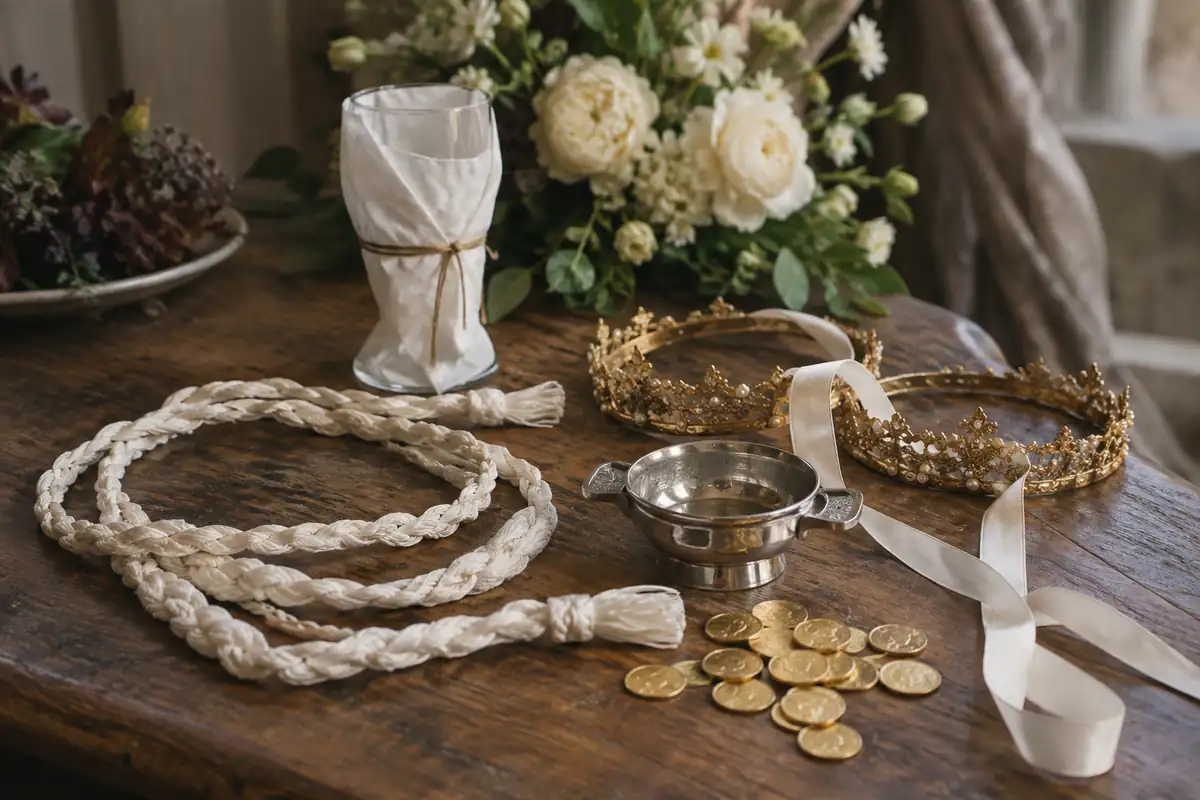
The arras are thirteen coins, usually gold or gold-colored and often presented in a small box or on a tray. During a Catholic ceremony the priest blesses them, and they pass between the couple — traditionally from groom to bride — as a promise to share everything they have and to provide for their household together. The number thirteen is usually explained as Christ and the twelve apostles; some families say it is one for each month and one more for the poor. The arras custom comes from Spain and is found throughout the Spanish-speaking world. Many families keep the same set of coins and pass them down from one wedding to the next.
The ceremony
Puerto Rico’s weddings have deep Catholic roots, and a church wedding, often with a full Mass, remains common — particularly in the old colonial churches of San Juan and the island’s town plazas. Civil ceremonies, Protestant and evangelical services and outdoor weddings on beaches and at haciendas are all common too. Readings and vows are often in Spanish, English or both. Our guide to the order of the ceremony covers the structure most services follow; many couples choose religious readings in both languages.
At a Puerto Rican wedding, nobody leaves without a capia — and nobody is surprised when the party is still going at two in the morning.
Capias
The capia is the custom guests remember. It is a small keepsake — traditionally a narrow ribbon, often satin in the wedding colors, printed or embroidered with the couple’s names and the date, and finished with a tiny flower, bow or charm. During the reception, the bride, the groom or members of their families move from table to table pinning a capia on every guest. It’s a way of thanking each person for coming and of making sure the couple greets everyone. Guests keep them; many Puerto Rican families have a drawer of capias from decades of weddings.
Capias were once made entirely by hand, often by the women of the family in the weeks before the wedding. Many still are.
La muñeca
The muñeca — the doll — is a doll dressed as the bride, in a miniature version of her gown, placed on the head table or beside the cake. Very often the capias are pinned to the doll’s skirt, and they are taken from her to be pinned on the guests. Afterwards the doll is kept as a memento of the day. It is one of the most distinctively Puerto Rican wedding customs.
The reception
Puerto Rican receptions are long, loud and joyful, and they are built around music and dancing.
The music. A live band — an orquesta — is the ideal, playing salsa, merengue and bachata, and often bomba and plena, the island’s Afro-Puerto Rican rhythms, which can turn a dance floor into a circle of clapping, drumming guests. Some couples choose a danza, the island’s elegant nineteenth-century ballroom music, for the father-daughter dance or their first dance. Our reception music library has suggestions for each moment.
The money dance. At many receptions, guests pin money to the bride’s and groom’s clothes, or drop it in a bag, for a turn dancing with them. The money is a gift to help the couple begin their married life.
The food. A Puerto Rican wedding menu might include lechón (slow-roasted pork), arroz con gandules (rice with pigeon peas), pernil, tostones, and, at a Christmas-season wedding, pasteles and coquito, the island’s spiced coconut eggnog.
The cake. The traditional Puerto Rican wedding cake — the bizcocho de boda — is a light cake soaked in syrup, often laced with rum, filled with fruit such as pineapple or guava, and covered in a glossy white meringue frosting. It is lighter and sweeter than an American buttercream cake and very well suited to a warm evening. For sizing and ordering, see ordering the wedding cake.
Getting married in Puerto Rico
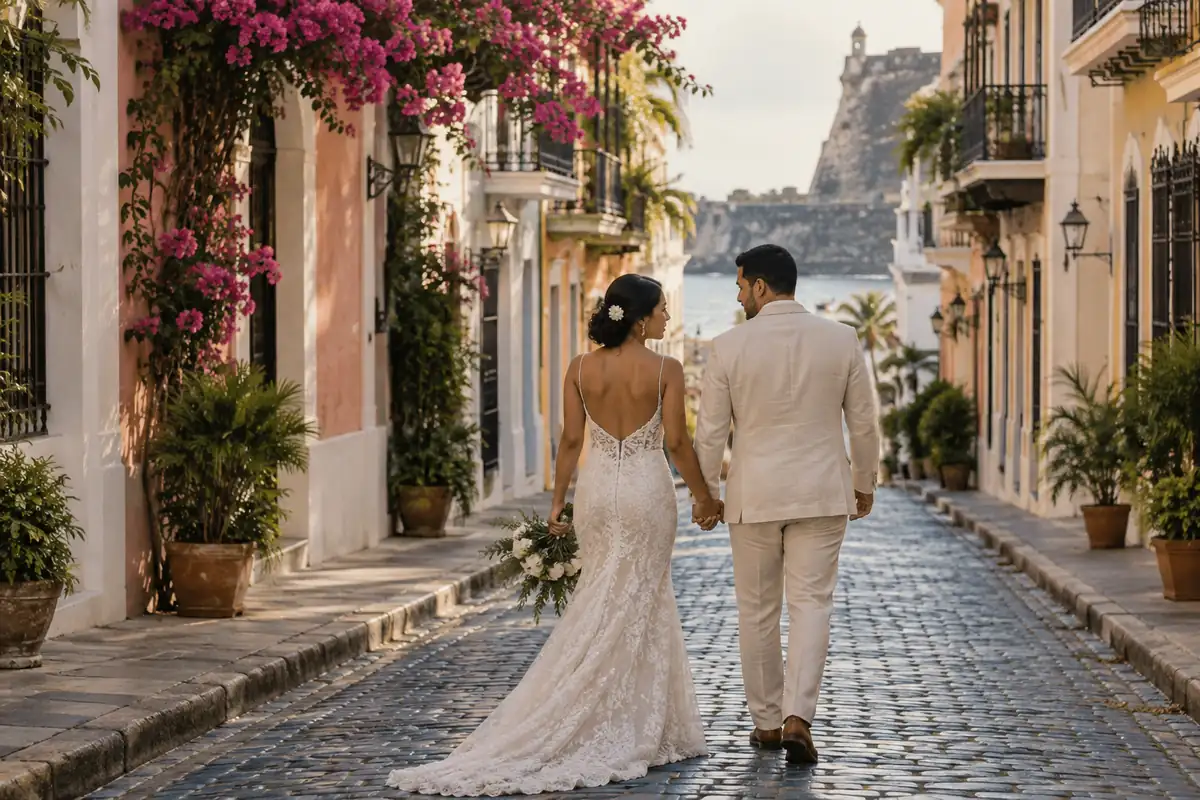
Puerto Rico is a US territory, so American citizens can marry there without a passport, and the island is one of the most popular Caribbean destinations for weddings and honeymoons. Old San Juan, with its blue cobblestones, colonial churches and fortress walls, is the classic setting; the west coast around Rincón and the islands of Vieques and Culebra offer beaches and quieter weddings.
Two practical notes:
The paperwork has its own rules. Marriage licenses are issued through Puerto Rico’s Demographic Registry, and the island has historically required documents — including a medical certificate — that most US states dropped long ago. Check the current requirements well in advance, or work with a local planner who handles them routinely.
Mind the season. The Atlantic hurricane season runs from June through November, peaking in late summer and early autumn. The dry season, roughly December to April, is the most reliable — and the busiest. See planning the honeymoon for more on seasons and insurance.
Borrowing a tradition
Many couples who aren’t Puerto Rican have fallen in love with capias in particular: they are a warmer thank-you than most favors, cost very little, and give the couple a reason to greet every guest. If you want to adopt one, adopt it knowingly — and if your partner’s family is Puerto Rican, ask the grandmothers how it was done in their day. For customs from elsewhere, see wedding traditions around the world; for the familiar Anglo-American ones, see something old, something new.
Today's Weddings shares its home with BodasPR, our Spanish-language sister site for weddings in Puerto Rico.
Written and edited by the Today’s Weddings editors. How we research and check what we publish is set out in our editorial standards. Spotted something wrong? Tell us.