Wedding Dress Preservation: Cleaning and Storing Your Gown
What happens after the wedding decides whether the dress is still ivory in thirty years. When to clean it, what preservation involves, how to store it and what else it could become.
Every wedding dress comes home dirtier than it looks. The hem has been across a lawn or a church floor, the underarms have done a long day’s work, and somewhere on the skirt there is almost certainly a drop of champagne. The Association of Wedding Gown Specialists, an industry group founded in 1987, notes that sugary drinks and cake can dry without leaving any visible mark and then, over time, caramelize into brown stains. A dress put away as it came off the dance floor can look very different when the box is opened for a daughter’s engagement. Cleaning and preservation are how you prevent that.
When to clean it
As soon as you reasonably can. Ideally, someone takes charge of the dress on the wedding night, hangs it or lays it flat, and delivers it to a cleaner within a couple of weeks. If you are going straight on honeymoon, ask a parent or a member of the wedding party to take it for you and tell them what happened to it: red wine at dinner, grass at the photos, the bustle ribbon that tore.
Don’t try to treat stains yourself on the night beyond blotting gently with a clean white cloth. Rubbing, soda water and stain pens can set marks or leave rings on silk.
What professional preservation involves
Inspection. A specialist examines the dress, notes the fabrics, beading and trims, and records stains and damage. Ask for a written note of both.
Cleaning. Methods depend on the fabric and the dress’s construction. Specialists will spot-treat stains, including sugar and oil stains that aren’t yet visible, and clean the dress by a method suited to silk, lace, tulle or beading. Beads and sequins may be tested first, since some are glued on or dyed.
Repair. Loose beads, torn tulle, a broken zipper or bustle loops can often be repaired at this stage for an additional charge.
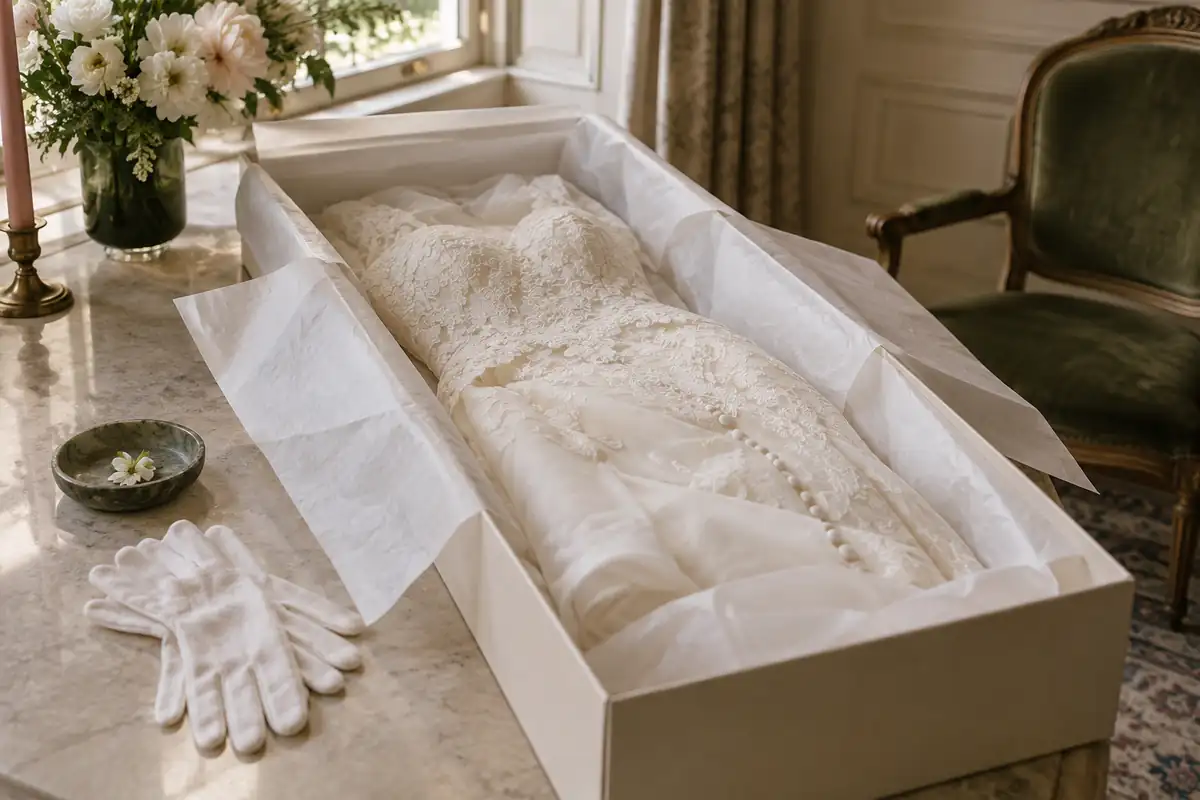
Pressing and packing. The dress is pressed and folded around acid-free tissue, with folds padded so they don’t set into permanent creases, and placed in an acid-free box. The Association of Wedding Gown Specialists stresses that the box should be completely acid-free, not just pH-neutral, since a neutralizing treatment can wear off.
Accessories. Veils, headpieces, gloves and petticoats can be preserved with the dress. Shoes should be stored separately, because the leather and adhesives can harm fabric.
What it costs
Prices vary by region, service and the complexity of the dress. As one national benchmark, The Knot’s mail-in preservation service listed cleaning and preservation at $299 and cleaning only at $259 in September 2026, with packages including accessories costing more. Local specialists usually quote per dress; heavily beaded, couture or very large gowns cost more, as do repairs. Ask whether the price includes return shipping, stain treatment, repairs and a written guarantee against yellowing.
A box you can open and inspect is better than a box you are told never to open.
The sealed box debate
Some preservation companies seal the dress in a box, sometimes with a viewing window, and tell customers not to open it. The argument for sealing is that it protects the dress from light, dust and handling. The argument against is simple: if you can’t look, you can’t know whether the dress was cleaned properly, whether it is yellowing, or whether it is even your dress.
Museum conservators store textiles so that they can be checked. The Canadian Conservation Institute’s guidelines for storing costume call for acid-free tissue or prewashed cotton sheeting, padded folds, cool and stable conditions, and regular inspection, and advise against ordinary plastic bags.
Our advice: Choose a service that lets you inspect the dress before it is packed or on its return, and ask whether opening the box voids the guarantee. The Association of Wedding Gown Specialists, for one, says that opening its preservation chest won’t void its guarantee. Then look at the dress once a year or so, with clean hands or cotton gloves, and refold it along slightly different lines.
Storing it yourself
If you would rather store the dress yourself after a professional cleaning, it is straightforward.
- Use an acid-free box large enough to hold the dress without crushing, and acid-free tissue. Archival suppliers sell wedding dress kits.
- Pad every fold with crumpled acid-free tissue so the fabric doesn’t crease sharply.
- Wrap it in washed, unbleached cotton, such as a clean cotton sheet, if you prefer to hang it or have no box.
- Keep plastic away. Conservators advise against dry-cleaning bags and ordinary plastic, which trap moisture against the fabric.
- Avoid hanging heavy gowns. The weight of a skirt pulls at the shoulders over time. Hang only light dresses, from a padded hanger, and support the weight with the dress’s hanging loops.
- Choose the right place. An interior closet or under a bed in a room kept at a comfortable temperature. The Association of Wedding Gown Specialists puts it plainly: attics are too hot and basements too damp. Keep it off outside walls and out of sunlight.
- Check it regularly for yellowing, insects and damp.
Heirlooms, remakes and repurposing
Wedding dresses have been handed down for as long as they have been kept. Queen Victoria’s Honiton lace, made for her 1840 gown, was later reused by her descendants for their own weddings and christenings. Many brides now wear a mother’s or grandmother’s dress, restyled.
Wearing a family dress. A preserved dress may need specialist cleaning and repair before it is altered. A skilled seamstress can add or remove sleeves, change the neckline, replace a zipper or reshape the skirt, though as wedding dress alterations explains, a dress can rarely be made much larger. Using the lace or the veil alone is a lovely alternative. Something old explains where the tradition comes from.
Remaking it. A dress can become a christening gown, a cocktail dress, a set of ring pillows, handkerchiefs or a quilt. Keep a sample of fabric or lace before you begin.
Selling or donating it. If you won’t keep it, cleaning the dress first will help it sell. Secondhand, rental and sample dresses covers resale and charities.
Wearing it again. Some couples take the dress out for a day-after or anniversary shoot; the day-after shoot explains how to plan one without ruining the dress. For milestone anniversaries, see anniversary gifts by year.
Written and edited by the Today’s Weddings editors. How we research and check what we publish is set out in our editorial standards. Spotted something wrong? Tell us.