Jacqueline Bouvier and John F. Kennedy’s Wedding, 1953
A young senator, a society bride and 1,200 guests at an oceanfront estate in Newport. The wedding dress was made twice, in a matter of days, by a designer the newspapers did not name.
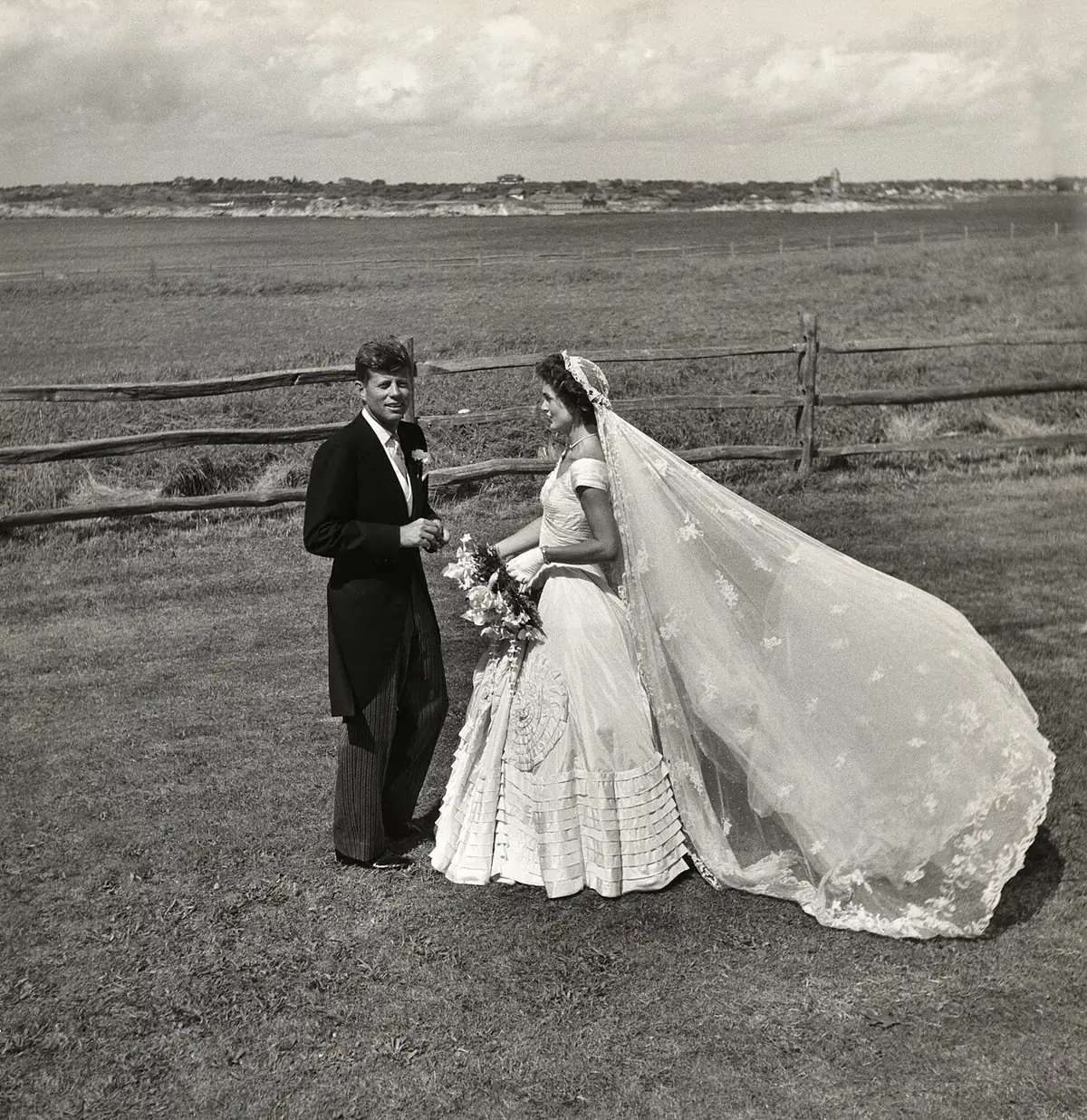
When Jacqueline Bouvier married John F. Kennedy in Newport in September 1953, the society pages reported the gown in detail and left out the name of the woman who made it. Ann Lowe, a Black designer born in Alabama, had made the dress twice: a burst pipe in her New York workroom ruined the first version ten days before the wedding, and she and her staff remade it and the bridesmaids’ dresses in little over a week. She absorbed the loss herself. Seventy years later, her name is the part of the story people most want to hear.
| At a glance | |
|---|---|
| Date | Saturday, September 12, 1953 |
| Place (ceremony) | St. Mary’s Roman Catholic Church, Newport, Rhode Island |
| Reception | Hammersmith Farm, the Auchincloss estate in Newport |
| The dress (designer) | Ann Lowe |
| Guests | More than 800 at the church; more than 1,200 at the reception |
| Officiant | Archbishop Richard Cushing, assisted by four priests |
The couple
John F. Kennedy was then a senator from Massachusetts; the bride’s mother and stepfather, Hugh D. Auchincloss, gave the wedding. The groom’s father, Joseph P. Kennedy, took a hand in the arrangements, down to ordering the cake.
Kennedy was elected President in 1960 and was assassinated in Dallas on November 22, 1963.
The ceremony
The nuptial Mass was celebrated at St. Mary’s, the Roman Catholic church in Newport, by Archbishop Richard Cushing of Boston, a friend of the Kennedy family, with four priests assisting. A special blessing from Pope Pius XII was read before the Mass. The tenor Luigi Vena, from Boston, sang Gounod’s “Ave Maria.”
The bride’s sister, Lee, was matron of honor, and her stepsister Nina Auchincloss maid of honor. Ten bridesmaids included the groom’s sister Jean and his sister-in-law Ethel. Robert F. Kennedy was his brother’s best man. The bride carried a spray of pink and white orchids and gardenias.
The dress
The gown was ivory silk taffeta, with a portrait neckline that framed the shoulders, a fitted bodice worked in interwoven bands of tucking, and a bouffant skirt trimmed with bands of more than fifty yards of flounces and small wax flowers. With it she wore a rose point lace veil that had first been worn by her grandmother Lee, held by a tiara of lace and orange blossoms.
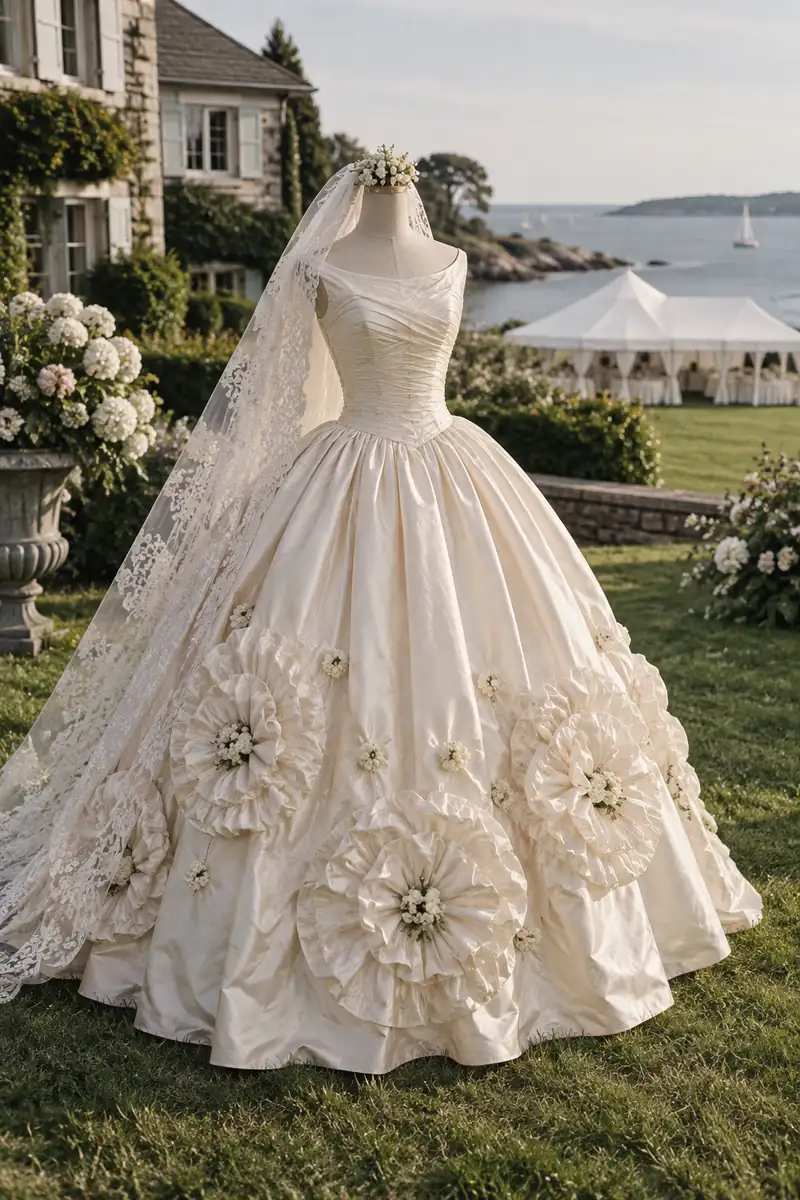
Ann Lowe, who made it, was born in Clayton, Alabama, in 1898. Her mother and grandmother were dressmakers to the prominent families of Montgomery, and she took over the business at sixteen, after her mother’s death. In 1917 she enrolled at the S.T. Taylor Design School in New York, which was segregated: she was taught alone, in a separate room. She finished the course in about six months. After running a salon in Tampa, she returned to New York, and by 1950 had her own salon on Lexington Avenue, dressing debutantes and brides from prominent society families. She was particular about her clients: “I love my clothes and I’m particular about who wears them,” she said.
Ten days before the wedding a water pipe burst in her workroom and destroyed the bride’s gown and the bridesmaids’ dresses. Lowe bought new fabric, gathered seamstresses, and remade everything in about eight days, work originally scheduled over eight weeks. She did not tell the family. Instead of the modest profit she expected, she lost $2,200 on the commission.
The dress is now in the John F. Kennedy Presidential Library and Museum in Boston. For how it compares with other famous gowns, see our guide to celebrity wedding dresses.
The reception
The reception was held on the terrace of Hammersmith Farm, the 300-acre oceanfront estate of the bride’s mother and her stepfather, Hugh D. Auchincloss. More than 1,200 guests came. Meyer Davis’s orchestra played, and the wedding cake, ordered by Joseph P. Kennedy, stood four feet tall.
Why it mattered
The wedding was a picture of the American society wedding of the 1950s at its most complete: a large church ceremony, a portrait neckline and a full taffeta skirt, a crowd of bridesmaids and a reception on a private estate by the sea. After the Kennedys reached the White House, its photographs became part of their public story.
But its later importance lies in Ann Lowe. Her name was left out of the newspaper coverage, and recognition came slowly. Today her work is held by the Metropolitan Museum of Art and the Smithsonian’s National Museum of African American History and Culture, and in 2023 the Winterthur Museum in Delaware gave her a major exhibition, Ann Lowe: American Couturier, which included a near-exact reproduction of the Kennedy gown. She died in 1981, in Queens. For another American wedding with a Kennedy at its center, see John F. Kennedy Jr. and Carolyn Bessette’s wedding.
Borrow the idea
Credit your makers. Name your dressmaker, florist and baker in your wedding program, your thank-you notes and any announcement. It costs nothing and it is the lesson of Ann Lowe’s story.
Wear the family veil. A grandmother’s lace veil can be cleaned and remounted on a new comb or headpiece; our guide to making your own veil covers the basics.
Consider a portrait neckline. It frames the collarbones and shoulders and suits a structured skirt. See how it compares with other shapes in the wedding dress, decoded.
Build in time. Lowe remade the dress in eight days, but you should not have to. Aim to have the dress finished at least two weeks before the wedding, and use our 12-month planning checklist to pace everything else.
Written and edited by the Today’s Weddings editors. How we research and check what we publish is set out in our editorial standards. Spotted something wrong? Tell us.