How to Have an Unplugged Wedding Ceremony
Asking guests to put their phones away for twenty minutes is one of the kindest requests a couple can make. How to word it, where to say it, and how to share every photograph afterward.
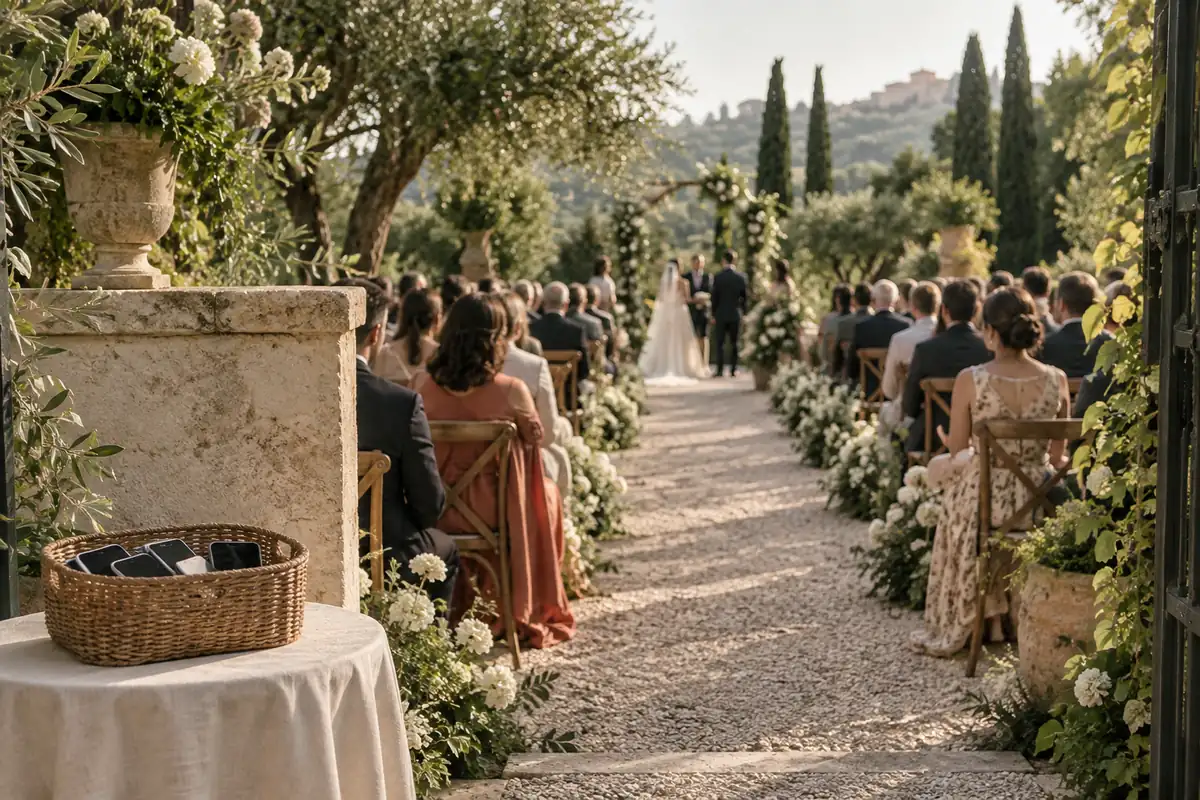
Look at enough wedding photographs and you notice a strange thing: the most common object in the ceremony pictures of the last decade is not a bouquet or a veil but the back of a phone. A guest leans into the aisle to film the processional. A row of screens rises for the kiss. The photographer you paid for has to work around them, and the people you invited to witness your marriage watch it through a four-inch rectangle.
An unplugged ceremony fixes that with a single, polite request. It is no longer unusual, and among younger couples it is close to standard. The Knot’s 2025 Real Weddings Study, which surveyed nearly 17,000 couples married in 2024, found that 62 percent of Gen Z couples and 54 percent of millennial couples favored an unplugged ceremony.
Why couples do it
For the photographs. A professional photographer can move around a guest or wait for a moment, but cannot remove an arm holding a phone from the center aisle. Unplugged ceremonies give your photographer and videographer clear sightlines, and the pictures you keep for decades are better for it.
For the guests. People who aren’t filming are watching. They hear the vows, see the expressions and are present for the thing they came for.
For privacy. Some couples would simply rather not have their ceremony posted by fifty people before they have seen it themselves.
Ceremony only, or the whole day
Most couples ask for an unplugged ceremony and leave the reception open, and this is the version we recommend. Twenty to forty minutes without a phone is an easy request; five hours is a difficult one, and the candid photographs guests take at the reception are often among the ones couples treasure most. If you want a fully unplugged wedding, say so clearly and early, and expect less compliance.
How to word the request
Keep it short, warm and specific about when phones can come back out. The following wording is our own; adapt it freely.
For the wedding website or the invitation insert:
We’d love you to be fully present with us during the ceremony, so we’re asking everyone to keep phones and cameras away until we’ve walked back down the aisle. Our photographer will capture every moment, and we’ll share the pictures with you. Once the reception begins, snap away.
For a sign at the ceremony entrance:
Welcome to our unplugged ceremony. Please silence your phones and keep them tucked away. Our photographer has it covered — we’d rather see your faces than your screens.
A shorter version:
Please be with us, not your phone. The photographs are coming.
Avoid wording that scolds or sounds like a threat. The request works because it is gracious; a sign that reads like a parking notice undoes it.
Where to say it
The wedding website. Put the request in the FAQ or on the schedule page, so guests know before they arrive. Our guide to wedding websites and digital invitations covers what else belongs there.
A sign at the entrance. An easel sign or a framed card where guests find their seats. Keep it legible from a few feet away and match it to the rest of your stationery.
The officiant’s announcement. This is the step that actually works. A sign is easy to miss; a person asking the room directly, a minute before the processional, is not.
The officiant’s announcement
The officiant (or a coordinator, or a designated friend) should step forward once guests are seated and the music is ready to change. Something like:
Good afternoon, everyone, and welcome. Before we begin, Sam and Priya have one request. They’ve asked that we keep our phones and cameras away for the ceremony, so that we can all be here with them — and so their photographer can do their best work. Please take a moment now to silence your phones and put them away. You’ll have every chance to take pictures at the reception. Thank you.
Then pause long enough for people to actually do it. Ten seconds of silence while two hundred phones go into pockets is worth it. If a friend is officiating, add this to their script; our guide to having a friend officiate covers the rest.
A sign is easy to miss. A person asking the room directly, a minute before the processional, is not.
Handling the one who doesn’t listen
Someone always does. The couple should never deal with it. Ask an usher, a coordinator or a trusted friend in the front rows to quietly ask anyone filming to put the phone away, with a smile, and to leave it there if the person refuses. One phone does less damage than a scene.
It is kind to make an exception for guests who are watching on behalf of someone else, such as a relative streaming the ceremony for a grandparent who couldn’t travel. Better still, arrange a single designated livestream in advance so nobody needs to improvise.
How to share the photographs afterward
An unplugged ceremony is easier to accept when guests know they will get pictures. Tell them how.
A shared album. Create one before the wedding and share the link. Apple’s Shared Albums allow up to 100 participants and 5,000 photos and videos per album, according to Apple’s support pages. Google Photos albums can hold up to 20,000 items and can be shared by link with anyone, which is simpler when your guests use a mix of phones.
A QR code. Print a QR code that opens the shared album on a small card at each table, on the bar, or on the reception sign — with the web address written beneath it for guests who don’t scan codes. Test it on several phones before you print.
Your photographer’s sneak peek. Many photographers deliver a handful of edited images within days. Share a few with guests and tell them when the full gallery will be ready.
A content creator. If you want same-day footage without guests filming, a wedding content creator can work quietly alongside your photographer and deliver clips the same night.
For guests’ own reception photos, the archive’s photo tips for wedding guests is worth linking from your website. For the full running order of the ceremony you’re protecting, see the order of the ceremony.
Written and edited by the Today’s Weddings editors. How we research and check what we publish is set out in our editorial standards. Spotted something wrong? Tell us.