Queen Elizabeth II and Prince Philip’s Wedding, 1947
Two years after the war, the heir to the throne married at Westminster Abbey in a Hartnell gown bought, in part, with clothing coupons. It set the pattern for every royal wedding since.
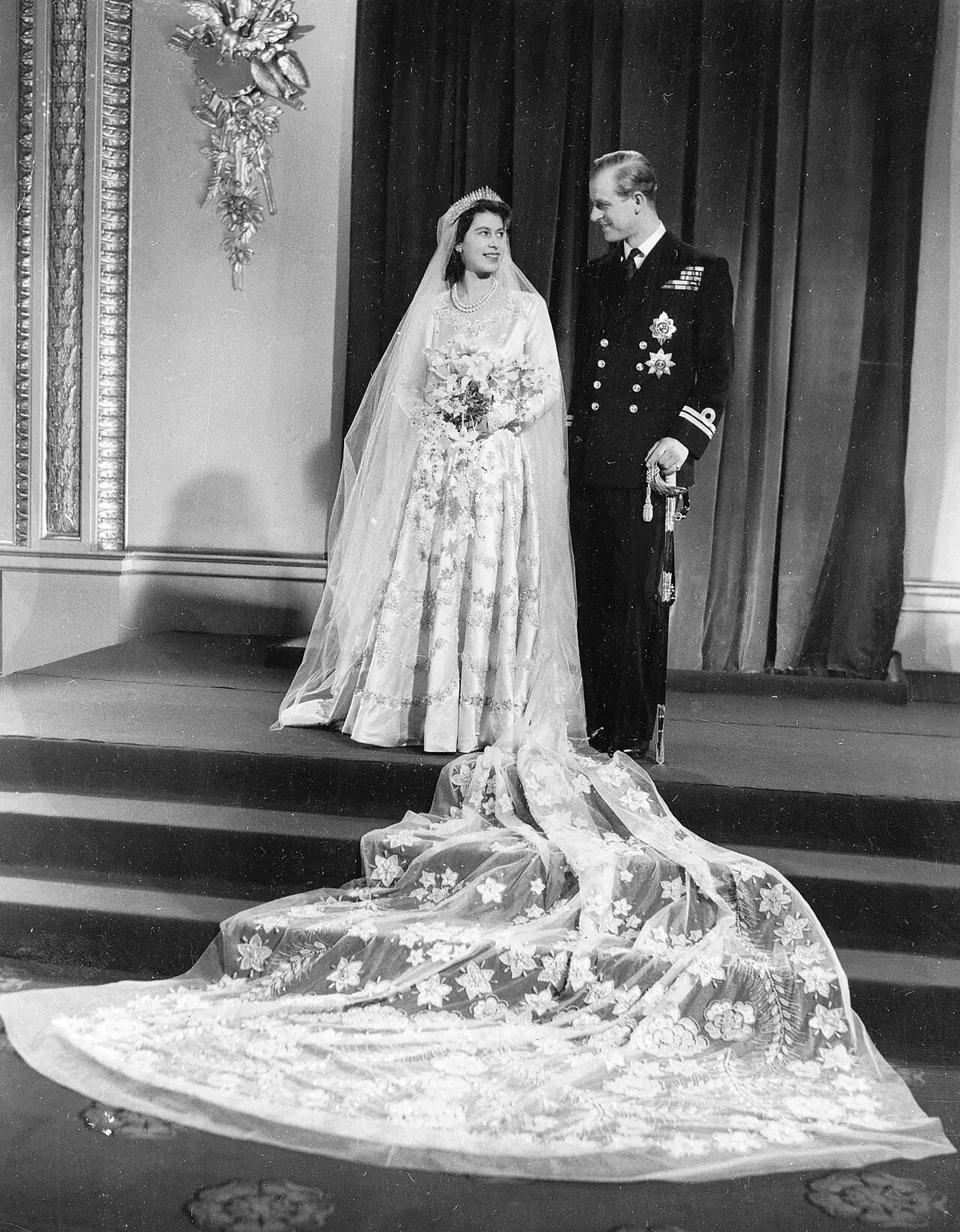
Britain was still living on ration books when Princess Elizabeth married Lieutenant Philip Mountbatten at Westminster Abbey on November 20, 1947, and the heir to the throne was bound by the same rules as every other bride: the materials for her wedding dress had to be bought with clothing coupons. The result was a day of real pageantry, planned within the limits of austerity, and it fixed the shape of a British royal wedding for the rest of the century.
| At a glance | |
|---|---|
| Date | Thursday, November 20, 1947 |
| Place (ceremony) | Westminster Abbey, London |
| Reception | Wedding breakfast in the Ball-Supper Room, Buckingham Palace |
| The dress (designer) | Norman Hartnell |
| Guests | 2,000 invited to the Abbey |
| Officiant | Geoffrey Fisher, Archbishop of Canterbury, with Cyril Garbett, Archbishop of York |
The couple
They first met in 1934, at the wedding of Princess Marina of Greece and Denmark to the Duke of Kent. Their engagement was announced on July 9, 1947. Before it, Philip, a prince of Greece and Denmark by birth, renounced his Greek and Danish titles, became a naturalized British subject and took the surname Mountbatten; he was received into the Church of England that October. On the morning of the wedding the King created him Duke of Edinburgh, Earl of Merioneth and Baron Greenwich.
Elizabeth became Queen on February 6, 1952. The marriage lasted 73 years, until Prince Philip died at Windsor Castle on April 9, 2021, making him the longest-serving royal consort in British history.
The ceremony
The bride traveled to the Abbey with her father, King George VI, in the Irish State Coach. Eight bridesmaids followed her, among them Princess Margaret and Princess Alexandra of Kent, with two young pages, Prince William of Gloucester and Prince Michael of Kent. The best man was the groom’s cousin David Mountbatten, Marquess of Milford Haven.
The Archbishop of Canterbury, Geoffrey Fisher, married the couple; the Archbishop of York, Cyril Garbett, gave the address. A fanfare by Arnold Bax opened the service, and Mendelssohn’s Wedding March played them out. The ring was made of Welsh gold from the Clogau St David’s mine, near Dolgellau. BBC Radio carried the service to an estimated 200 million listeners.
The dress
Norman Hartnell’s design was approved in mid-August, leaving about three months to make it. He took his inspiration from Botticelli’s Primavera, a painting of spring, and it suited the mood of a country waiting for better times. The gown was ivory duchesse satin, woven in Scotland near Dunfermline, with a fitted bodice, a heart-shaped neckline, a pointed waist and a long, full skirt. It was embroidered with crystals and some 10,000 seed pearls imported from the United States, and a 15-foot silk tulle court train fell from the shoulders.
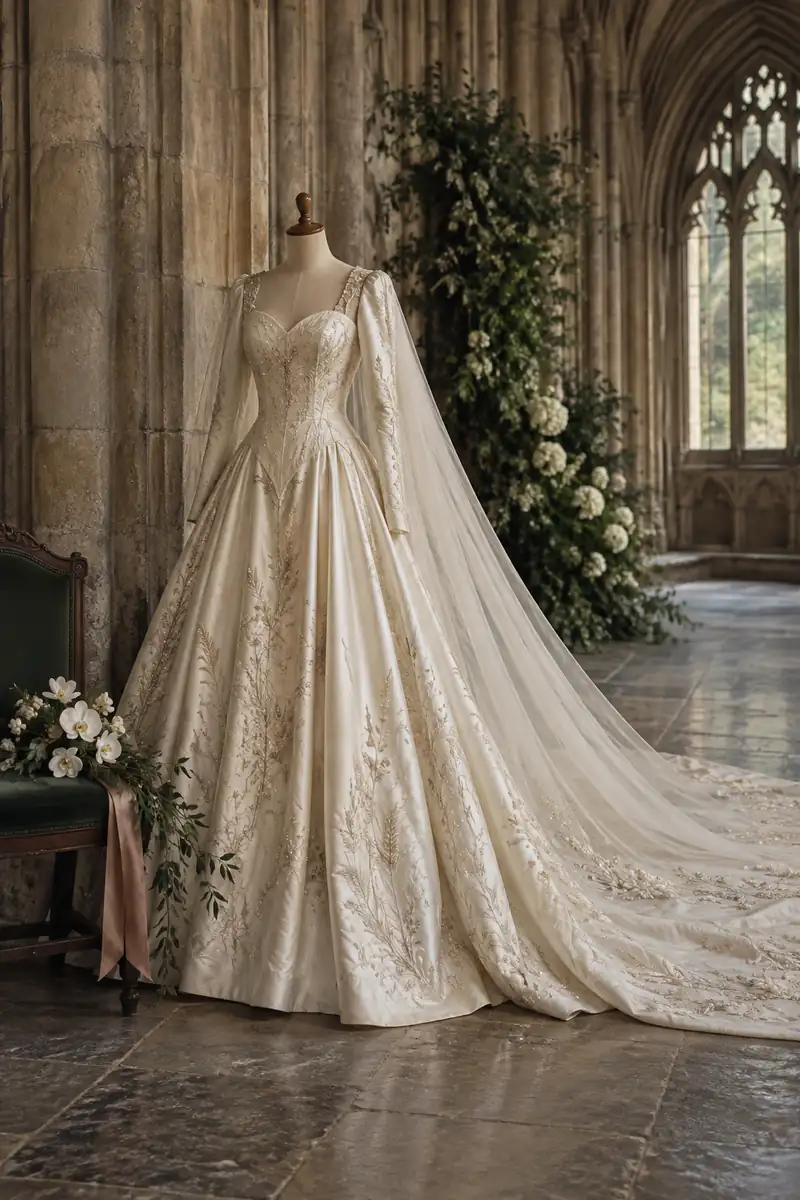
The coupons made the headlines. The Princess used her own, and hundreds of women sent theirs to help; they had to be returned, since using another person’s coupons was illegal. Her ivory satin sandals, trimmed with silver and seed pearls, were by Edward Rayne.
One small crisis has entered legend. The diamond fringe tiara snapped as it was being put on, and was mended in time by the court jeweler. She wore two pearl necklaces, the Queen Anne and the Queen Caroline, a wedding present from her father.
Her bouquet of white orchids included a sprig of myrtle, a tradition that began when Queen Victoria was given a myrtle by Prince Albert’s grandmother and planted it at Osborne House on the Isle of Wight. The day after the wedding the bouquet was sent back to the Abbey and laid on the Grave of the Unknown Warrior, as the bride’s mother had done with her own in 1923. You can see how the gown sits among other royal bridal dresses in our survey of royal wedding dresses.
The reception
The wedding breakfast was held in the Ball-Supper Room at Buckingham Palace, with the string band of the Grenadier Guards playing. The menu was named for the couple: Filet de Sole Mountbatten, Perdreau en Casserole and Bombe Glacée Princess Elizabeth. Each guest found a small posy of myrtle and white Balmoral heather as a favor. The newlyweds came out onto the palace balcony to wave to the crowds.
Eleven wedding cakes arrived. The official one, from McVitie and Price, stood nine feet high in four tiers and was known as the “10,000 Mile Cake” because its ingredients came from across the world, including sugar from Australian Girl Guides. It was cut with the Duke’s Mountbatten sword, a present from the King.
More than 2,500 gifts arrived, among them a piece of cotton lace spun by Mahatma Gandhi. The gifts and the dress were put on public display at St James’s Palace, and the gown then toured Britain.
The couple spent their wedding night at Broadlands in Hampshire, the home of Philip’s uncle, Earl Mountbatten, and the rest of their honeymoon at Birkhall on the Balmoral estate.
Why it mattered
Much of what we now think of as a royal wedding was set here, or confirmed here: the Abbey, the Welsh gold ring, the myrtle in the bouquet, the bouquet laid on the Unknown Warrior’s grave, the balcony appearance. The dress, with its sweetheart line, fitted bodice and long court train, went on tour after the wedding, so that thousands of people saw it at close quarters. And the story of the coupons gave the day an unusual quality. It was a grand wedding that ordinary people could recognize. The next great royal wedding of the century, Charles and Diana’s in 1981, was larger still; Princess Beatrice wore the same fringe tiara in 2020.
Borrow the idea
Give guests a sprig of something. The posies of myrtle and heather are a charming, inexpensive favor. Herbs from a family garden, tied with ribbon, do the same job; our guide to flower meanings will help you choose.
Wear something with a history. A grandmother’s pearls, a mother’s earrings, a borrowed tiara: the custom behind something old, something borrowed was never about expense.
Plan for the snapped tiara. Something always goes wrong on the morning. A well-stocked emergency kit and a calm friend with a needle are the modern court jeweler.
Make the bouquet a tribute. Laying your flowers on a grandparent’s grave, or at a war memorial, the day after the wedding is a quiet and moving gesture.
For the other great royal ceremonies, see The Great Royal Weddings.
Written and edited by the Today’s Weddings editors. How we research and check what we publish is set out in our editorial standards. Spotted something wrong? Tell us.